Parallel universes and alternate realities have captured human imagination for generations. Scientists and philosophers continue to explore these fascinating ideas that suggest different versions of reality exist alongside our own.

The multiverse theory proposes that our universe is just one of many, with different physical constants and laws governing each one. These alternate realities might contain different versions of you making different choices, or completely different laws of physics altogether.
When you think about parallel universes, you’re really questioning the fundamental nature of reality and existence. The concept challenges our understanding of space, time, and consciousness itself.
Key Takeaways
- Multiple universes may exist simultaneously, each with unique physical laws and constants
- Every quantum decision could create branching timelines in parallel realities
- Your choices might lead to different outcomes across various alternate universes
Conceptual Overview of Parallel Universes
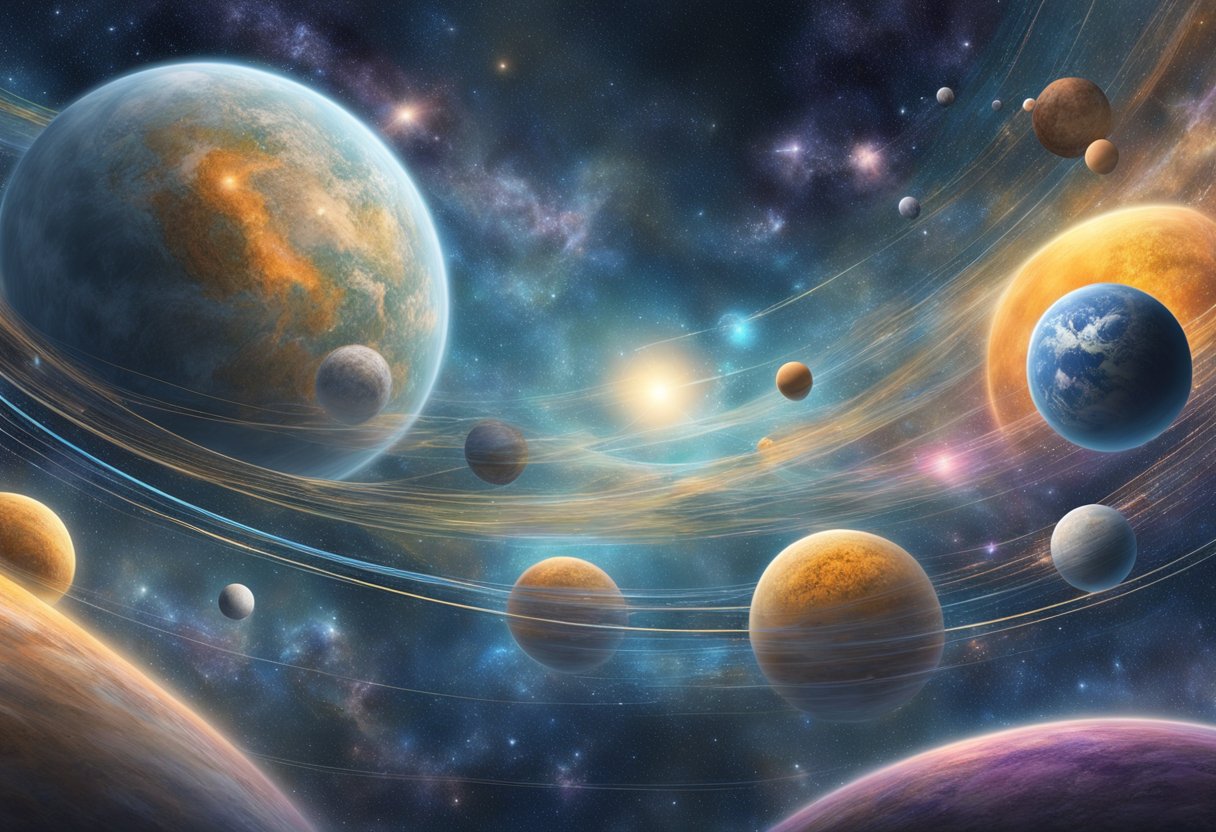
The idea of multiple universes exists beyond science fiction. Scientists and philosophers explore mathematical models that suggest countless other universes exist parallel to our own.
Fundamentals of Multiverse Theories
When you think about parallel universes, picture an infinite set of realities existing side by side. The multiverse theory suggests these universes contain their own unique physical laws, constants, and properties.
Each universe might differ from ours in small or dramatic ways. You could exist in many of these universes, making different choices in each one.
Key features of multiverse theories include:
- Quantum events creating branching timelines
- Different physical constants in each universe
- Separate space-time continuums
- Varying laws of physics
Philosophical Underpinnings
The concept of parallel worlds raises deep questions about the nature of reality and existence. You must consider what it means for multiple versions of yourself to exist simultaneously.
Ancient philosophers first explored these ideas, contemplating the possibility of other worlds beyond our own. Modern philosophy examines how parallel universes affect our understanding of:
- Free will and determinism
- Identity and consciousness
- Causality and choice
- The nature of possibility
These concepts challenge your basic assumptions about reality and existence.
Scientific Foundations

Modern physics and cosmology point to multiple ways that parallel universes could exist. The math and observations behind quantum mechanics, cosmic inflation, and radiation from the early universe all suggest a reality far bigger than our own.
Quantum Mechanics and Many-Worlds
At tiny scales, particles can exist in multiple states at once until measured. This strange behavior led physicist Hugh Everett to propose the many-worlds interpretation in 1957.
When you measure a quantum particle, the many-worlds theory says reality splits into different branches. Each branch represents one possible outcome.
This means quantum events create new universes constantly. If you flip a coin, one universe sees heads while another sees tails.
Scientists like Stephen Hawking supported this view. The math behind quantum mechanics works perfectly with the idea of branching realities.
Cosmic Inflation and Bubble Universes
The early universe expanded incredibly fast during cosmic inflation. This rapid growth may still be happening in other regions, creating new “bubble universes” separate from our own.
Each bubble universe could have different physical laws and constants. Your universe might be just one bubble in a vast cosmic foam.
The inflation theory explains why space looks so uniform in all directions. It also predicts that the process never completely stops.
Role of Cosmic Microwave Background Radiation
The cosmic microwave background (CMB) radiation fills all of space. It comes from about 380,000 years after the Big Bang.
Scientists study tiny temperature variations in the CMB. These patterns can reveal clues about other universes that may have bumped into ours.
Recent research suggests some CMB “cold spots” might be evidence of neighboring universes. The patterns match what physicists expect from cosmic collisions between bubble universes.
Manifestations of Parallel Universes
Scientists have found compelling signs of multiple universes through quantum physics experiments and space observations. Advanced tools like the Planck satellite provide data that supports these findings.
Evidence from Quantum Events
Quantum mechanics suggests multiple realities exist simultaneously. When you observe quantum particles, they can exist in many states at once.
The famous double-slit experiment shows particles behaving as if they interact with unseen versions of themselves. This matches predictions about parallel universes affecting each other at the quantum level.
Scientists measure these quantum effects in labs using ultra-sensitive equipment. The results consistently show particles acting in ways that only make sense if multiple realities exist.
Empirical Observations and Theoretical Implications
The Planck satellite’s measurements of cosmic radiation reveal patterns that hint at other universes bumping into ours. These cold spots in space suggest places where parallel universes may have touched our own.
Mathematical models in string theory predict at least 10 dimensions, with many separate universes existing in bubble-like spaces. Each universe might have different physical laws than what you experience.
Recent calculations show these bubble universes could leave traces we can detect. Scientists look for these signs using powerful telescopes and advanced sensors.
Cosmological and Scientific Implications
The idea of multiple universes shapes modern physics and changes how we think about reality itself. Scientific theories suggest your everyday world is part of something much bigger.
Influence on Theoretical Physics
String theory proposes multiple dimensions beyond the four you can observe. These extra dimensions could contain other universes with different physical laws.
Your understanding of quantum mechanics reveals strange behaviors at tiny scales. When particles act in unexpected ways, it might mean they’re interacting with parallel realities.
The search for a Theory of Everything connects closely to multiverse ideas. You might find that the mathematics explaining our cosmos naturally points to many universes existing at once.
Implications for the Understanding of Dimensions and Reality
Your perception of reality may be limited to just a tiny slice of what actually exists. New research suggests the universe you see could be one of countless alternate versions.
The ultimate multiverse concept proposes that every possible reality exists somewhere. This means you might have versions of yourself living different lives in other universes.
Modern physics shows your reality isn’t as solid or singular as it seems. When you look deep enough into the fabric of space and time, you find evidence that multiple dimensions and alternate realities could be woven into the basic structure of existence.
Philosophical and Existential Inquiries
The existence of parallel universes raises deep questions about your choices and the very nature of who you are. These questions challenge basic ideas about human consciousness and decision-making.
Free Will and Determinism
When you make a choice, parallel realities may branch off – each representing a different decision you could have made. This suggests every possible choice exists somewhere.
Your decisions might not just affect one reality, but create multiple new timelines. This challenges traditional ideas of free will.
Some philosophers argue that if all possible choices exist, true free will becomes meaningless. Others say the ability to create new realities through choices proves free will exists.
Identity and Consciousness in Parallel Realities
The existence of other universes raises fundamental questions about who you truly are. If versions of you exist in countless realities, which one represents your true self?
Your consciousness might be unique to this reality, or it could be connected across multiple universes. This idea challenges basic assumptions about personal identity.
Scientists and philosophers debate whether each version of you has its own separate consciousness, or if there’s one consciousness experiencing multiple realities simultaneously.
The question of whether memories and experiences are shared between parallel versions of yourself remains a key point of debate in both science and philosophy.
Frequently Asked Questions
The scientific community explores parallel universes through quantum mechanics, mathematical models, and theoretical physics. Many questions arise about the nature of these alternate realities and their relationship to our own existence.
Can we prove the existence of parallel universes through scientific methods?
Scientists use quantum mechanics experiments to study potential evidence of parallel universes. These experiments focus on particle behavior and quantum superposition.
Current technology limits direct observation of parallel universes. Mathematical models and theoretical frameworks provide indirect evidence for their possible existence.
What is the difference between a multiverse and parallel universes?
The multiverse theory suggests multiple universes exist simultaneously. Parallel universes are specific instances within the multiverse where alternate versions of reality unfold.
Each parallel universe contains different versions of events and choices. The multiverse encompasses all possible parallel universes and their variations.
How does the concept of parallel universes fit within the framework of quantum physics?
Quantum mechanics suggests that particles can exist in multiple states simultaneously until observed. This quantum behavior may indicate the presence of parallel realities.
When quantum events occur, reality might split into different branches. Each branch represents a unique outcome in a separate universe.
Are there any credible theories that suggest the possibility of contacting alternate versions of ourselves?
Current physics theories do not support direct communication between parallel universes. The barriers between universes appear to prevent interaction between alternate versions of reality.
In what ways do alternate realities or parallel universes play a role in theoretical physics?
The many-worlds interpretation explains quantum phenomena through branching universes. This theory helps physicists understand quantum behavior and probability.
Parallel universe theories provide frameworks for studying quantum mechanics and cosmic inflation. These concepts help explain observations that challenge classical physics.
What are the implications of parallel universe theories on our understanding of reality?
Quantum immortality suggests consciousness might continue in other universes even after death in one reality. This concept challenges traditional views of existence and consciousness.
The possibility of infinite parallel universes implies that all potential choices and outcomes exist somewhere. This idea raises questions about free will and determinism.





Leave a reply to Cosmic Constants: Patterns, Geometry, and the Unity of Nature – Potent U Cancel reply