You don’t have to wait for your mood to change on its own. NLP state management gives you the ability to consciously control your emotional state through movement, breathing, inner imagery, and language. Your emotions are not random reactions beyond your control. They follow patterns you can learn to redirect in the moment you need it most.
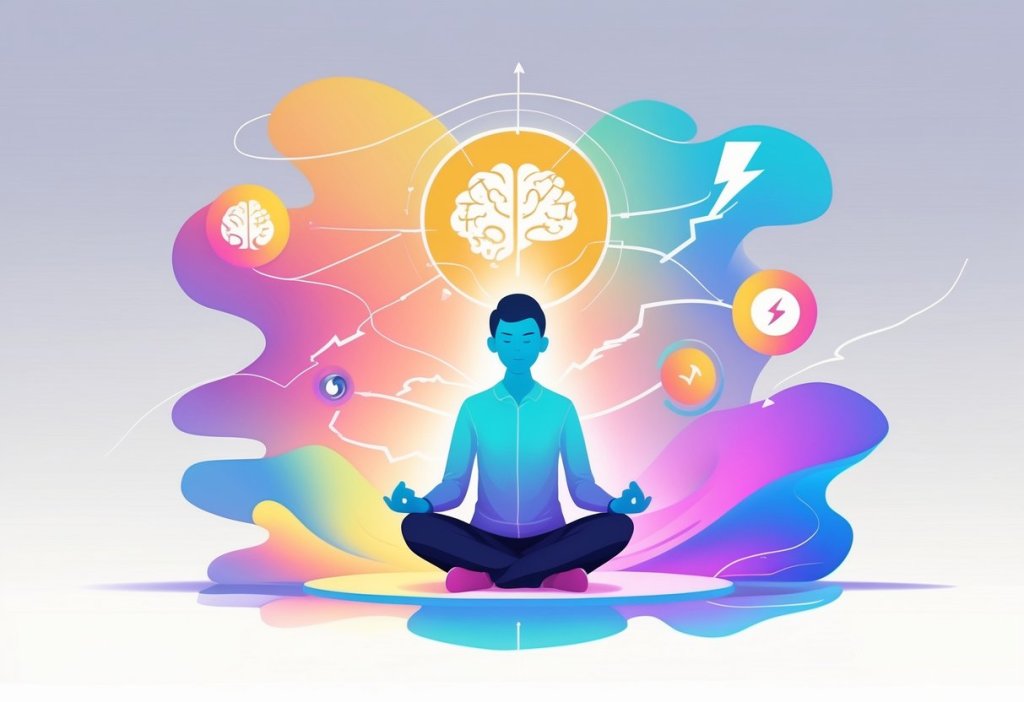
Most people believe they are stuck with whatever mood shows up. They wait for motivation to strike or hope bad feelings will pass. But there is a small gap between what happens to you and how you respond. In that space, you can choose how to feel, think, and act. Learning to use this gap changes everything about how you move through your day.
The techniques in this guide work fast. You will learn how to shift your emotional state using simple physical changes, mental strategies, and pattern interrupts. These are practical tools you can use before a presentation, during a stressful conversation, or any time you need to reset your mindset. No special training required.
Key Takeaways
- You can change your emotional state instantly through body posture, breathing, and movement
- NLP anchoring lets you link a specific gesture or word to a positive feeling you can activate on demand
- Pattern interrupts and submodalities help you break negative thought loops and adjust how you experience emotions
——————————————————————————————
Here are some related books to help your on your journey:
1. Frogs into Princes: Neuro Linguistic Programming
2. Awaken the Giant Within
3. Using Your Brain–For a Change: Neuro-Linguistic Programming
FYI – If you decide to purchase any of the above book recommendations, Potent U will get a small referral fee from Amazon. This fee does not affect the price you pay. You would pay the same price regardless. Thank you for your support!
——————————————————————————————
Mastering Emotional State Control With NLP
NLP provides practical tools to shift your emotional state by working with how your brain processes experiences. You can learn to access resourceful states when you need them most through specific techniques that target your internal representations.
Understanding Neuro-Linguistic Programming
Neuro-linguistic programming is a method that examines how your thoughts, language, and behavior patterns create your experience. The “neuro” part refers to your nervous system and how you process information through your senses. The “linguistic” element addresses how you use language internally and externally to shape meaning.
NLP started in the 1970s by studying how successful people achieved their results. Practitioners discovered that excellence comes from specific mental patterns you can learn and apply.
When you understand these patterns, you gain access to powerful NLP techniques to control thoughts and emotions. Your brain codes experiences through visual images, sounds, and physical sensations. By changing these internal codes, you change how you feel about any situation.
Principles of State Management
State management refers to your ability to consciously shift your emotional and mental condition. Your current state determines what actions you take and what results you get.
You can intentionally control emotions rather than waiting for external circumstances to change. State management skills work in every area of your life—relationships, career, health, and personal growth.
The key principle is that you are not stuck in any emotional state. You can access a resourceful state by adjusting three elements:
- Physiology: Your posture, breathing, and movement patterns
- Focus: Where you direct your attention and what you visualize
- Language: Your internal dialogue and the words you choose
Small changes in these areas create immediate shifts in how you feel.
The Power of Emotional Regulation Techniques
Emotional regulation techniques give you practical ways to manage your state in real situations. These aren’t about suppressing feelings but about choosing responses that serve your goals.
One effective method uses submodalities to shift your emotional state by adjusting the qualities of your internal images and sounds. You can make a stressful memory less intense by changing its brightness, distance, or size in your mind.
Another approach is anchoring, which creates triggers to access emotional states on demand. You link a physical gesture or word to a feeling of confidence or calm, then activate that anchor when needed.
Pattern interrupts break negative thinking loops by introducing unexpected elements. When you catch yourself in an unproductive state, you can physically move, change your breathing, or ask yourself a different question to reset your mental pattern.
——————————————————————————————
Here are some related books to help your on your journey:
1. Frogs into Princes: Neuro Linguistic Programming
2. Awaken the Giant Within
3. Using Your Brain–For a Change: Neuro-Linguistic Programming
FYI – If you decide to purchase any of the above book recommendations, Potent U will get a small referral fee from Amazon. This fee does not affect the price you pay. You would pay the same price regardless. Thank you for your support!
——————————————————————————————
Instant Mood Shifts and Pattern Interrupts
Your emotional state follows predictable loops that fire automatically when triggered. Breaking these loops through deliberate actions gives you immediate control over how you feel and respond.
How to Change Your Mood Instantly
Your brain links specific body positions, breathing patterns, and focus points to emotional states. When you change these physical elements, your mood shifts within seconds.
Stand up and adjust your posture first. Pull your shoulders back, lift your chest, and hold your head level. This position alone triggers different neurochemistry than slouching does.
Next, change your breathing pattern. Take six deep breaths where you inhale for four counts, hold for four counts, and exhale for six counts. This activates your parasympathetic nervous system and reduces stress hormones.
Move your body with purpose. Do 20 jumping jacks, shake your arms vigorously, or walk briskly for two minutes. Physical movement interrupts emotional loops because your brain must process new sensory input.
Focus your attention on something specific outside yourself. Count backwards from 100 by sevens, describe five things you can see in detail, or solve a simple puzzle. Shifting brain chemicals through focused attention creates mental clarity that disrupts negative patterns.
Pattern Interrupt Techniques for Fast Results
A pattern interrupt breaks the neurological loop of trigger, thought, emotion, and behavior. The technique works by introducing an unexpected element that stops the automatic response.
Physical Pattern Interrupts:
- Splash cold water on your face
- Change your location immediately
- Snap a rubber band on your wrist
- Touch something with a distinct texture
- Change your facial expression deliberately
Mental Pattern Interrupts:
- Ask yourself an absurd question like “What color is Tuesday?”
- Visualize your emotion as a color and change that color
- Say a word backwards letter by letter
- Count by prime numbers
Use these techniques the moment you notice an unwanted emotional state beginning. The key is speed and commitment. Half-hearted attempts won’t break the pattern effectively.
Combine multiple interrupts for stronger results. Stand up while splashing water on your face, then immediately walk to a different room while counting backwards.
Mental Reset and Mindset Shifting Methods
A mental reset technique creates a clean break from your current emotional state before building a new one. This process gives you self mastery skills that work on demand.
The 5-4-3-2-1 grounding method provides an instant mindset shift. Name five things you see, four things you can touch, three things you hear, two things you smell, and one thing you taste. This anchors you in the present moment and stops rumination.
Create a physical anchor for resourceful states. Press your thumb and forefinger together while recalling a time you felt completely confident. Repeat this 10 times with full emotional intensity. Later, using the same gesture helps trigger that confident state.
Quick Reset Sequence:
- Stop what you’re doing completely
- Take three deep breaths
- Roll your shoulders back five times
- State one thing you’re grateful for out loud
- Choose your next action consciously
Practice these resets when you don’t need them so they work automatically when you do. The patterns become stronger with repetition. Your ability to shift your mindset fast improves as you build these neural pathways through consistent use.
Practical NLP Techniques for Emotional Regulation
You can learn to shift your emotions by using specific NLP techniques that work with how your brain codes experience. These methods help you access confident states when needed, interrupt negative thought patterns, and build better emotional control through practice.
Anchoring for Emotions on Demand
Anchoring is a technique that lets you trigger specific emotional states by linking a physical action to a desired feeling. You create this connection when you’re already in a strong positive state.
Here’s how to set an anchor:
- Remember a time when you felt extremely confident
- Close your eyes and relive that moment fully
- As the feeling peaks, press your thumb and finger together firmly
- Hold for 5-10 seconds while the emotion is strongest
- Release and break your state by thinking of something neutral
Repeat this process 3-5 times to strengthen the connection. When you need confidence later, press your thumb and finger together the same way. Your brain will recall the emotional state you anchored.
The key is timing. You must trigger the physical anchor exactly when your positive emotion reaches its peak. This creates the strongest link between the action and the feeling.
Breaking Negative Thinking Patterns
Your inner critic often has specific characteristics in your mind—a certain tone, volume, or location. You can weaken negative thoughts by changing these qualities.
Try the pattern interrupt technique when you notice negative self-talk. Stop the thought mid-sentence and do something unexpected. Clap your hands, stand up quickly, or say “cancel” out loud.
You can also modify how the criticism sounds in your head:
- Turn down the volume of the critical voice
- Move it farther away from you
- Change the tone to something silly or cartoon-like
- Speed up the voice until it sounds ridiculous
These changes reduce the emotional impact of negative thoughts. Your brain takes the criticism less seriously when it sounds different.
Another approach is reframing. When you think “I always mess up,” ask yourself “What did I learn?” This shifts your focus from failure to growth.
Boosting Confidence Quickly
You can access confidence on demand by adjusting how you hold your body and what you picture in your mind. Your physical state directly affects your emotional state.
Stand up straight with your shoulders back and chest open. Take slow, deep breaths into your belly. Hold your head level and make your movements deliberate. This physiology shift tells your brain you’re confident.
Next, picture yourself succeeding at whatever you’re about to do. Make the image bright, colorful, and close to you. See yourself moving smoothly and confidently. Add positive sounds like encouraging words or upbeat music.
Combine this with your confidence anchor if you’ve created one. Press your thumb and finger together while maintaining strong posture and vivid mental imagery.
Practice this sequence regularly, not just before important moments. The more you rehearse accessing confidence, the faster and easier it becomes. Your brain builds stronger pathways to that state with repetition.
——————————————————————————————
Here are some related books to help your on your journey:
1. Frogs into Princes: Neuro Linguistic Programming
2. Awaken the Giant Within
3. Using Your Brain–For a Change: Neuro-Linguistic Programming
FYI – If you decide to purchase any of the above book recommendations, Potent U will get a small referral fee from Amazon. This fee does not affect the price you pay. You would pay the same price regardless. Thank you for your support!
——————————————————————————————
Submodalities: Fine-Tuning Your Emotional Experience
Your brain doesn’t just store memories and thoughts as simple files. It codes them with specific sensory details that control how strongly you feel about each experience.
What Are Submodalities?
Submodalities are the specific qualities that make up how your mind represents information through your senses. Think of modalities as the main channels your brain uses: visual (what you see), auditory (what you hear), and kinesthetic (what you feel). Submodalities are the fine adjustments within each channel.
When you remember a stressful event, your brain assigns specific properties to that memory. The image might be large and close to your face. The sounds might be loud or sharp. The feeling might sit heavy in your chest.
These aren’t random details. They determine how intense the emotion feels. A bright, close-up image of an embarrassing moment hits harder than a dim, distant one. A loud critical voice affects you more than a quiet whisper.
Visual, Auditory, and Kinesthetic Submodalities
Visual submodalities include properties like:
- Brightness: dim to brilliant
- Color: black and white to full color
- Size: small to large on your mental screen
- Distance: close or far away
- Movement: still image or movie
- Location: where it appears in your field of view
Auditory submodalities cover sound qualities such as:
- Volume: quiet to loud
- Pitch: low to high
- Direction: where the sound comes from
- Tone of voice: harsh, soothing, monotone, or varied
- Speed: fast or slow
Kinesthetic submodalities involve physical sensations like:
- Temperature: cold to warm
- Pressure: light to heavy
- Texture: smooth or rough
- Intensity: weak to strong
- Location: where you feel it in your body
Manipulating Submodalities for Lasting Change
You can adjust these sensory qualities to change how you feel about any thought or memory. Start by picking a mildly negative memory. Notice where the image sits in your mental screen. Is it in color or black and white?
Now move the image farther away. Make it smaller. Drain out some of the color. Lower the volume of any voices.
Most people feel the emotional charge drop immediately. The memory still exists, but it no longer controls your emotional state.
You can do the opposite with positive memories. Bring a confident moment closer. Make it brighter. Turn up the colors. Add movement. Feel where confidence sits in your body and increase the warmth or intensity there.
Practice these adjustments regularly to build stronger control over your emotional responses. The more you work with submodalities, the faster you can shift from unwanted states into resourceful ones.
——————————————————————————————
Here are some related books to help your on your journey:
1. Frogs into Princes: Neuro Linguistic Programming
2. Awaken the Giant Within
3. Using Your Brain–For a Change: Neuro-Linguistic Programming
FYI – If you decide to purchase any of the above book recommendations, Potent U will get a small referral fee from Amazon. This fee does not affect the price you pay. You would pay the same price regardless. Thank you for your support!
——————————————————————————————
Frequently Asked Questions
Simple body adjustments and mental techniques can create instant emotional shifts, while specific NLP methods help you break unwanted patterns and access confident states within seconds.
What techniques can I use for immediate mood alteration?
Your body position directly affects how you feel. Stand up straight, pull your shoulders back, and lift your chin to trigger a more confident emotional state in seconds.
Deep breathing activates your nervous system and can reset your emotional state in just 90 seconds. Take five slow breaths, filling your belly completely, then exhaling fully.
Movement changes your brain chemistry. Walk briskly for two minutes, do jumping jacks, or dance to an energetic song to shift your mood immediately.
Music serves as a powerful mood tool. Choose songs that match the emotional state you want to reach, not where you currently are.
How can the pattern interrupt technique be utilized for emotional regulation?
Pattern interrupts work by breaking your current thought cycle before it gains momentum. When you notice unwanted emotions building, do something unexpected like snapping a rubber band on your wrist or saying a random word out loud.
Physical interrupts prove most effective. Clap your hands three times, spin in a circle, or splash cold water on your face to jolt your system out of negative patterns.
The Mickey Mouse technique transforms critical inner voices. When negative thoughts appear, imagine them spoken in a squeaky, cartoon voice to remove their emotional power.
Change your physical location to interrupt emotional patterns. Move to a different room, step outside, or simply turn to face a new direction.
What are some effective NLP strategies for beginners to manage their emotional state?
Anchoring links a physical gesture to a desired emotional state. Think of a time you felt completely confident, squeeze your thumb and index finger together while reliving that feeling intensely, then repeat this process five times to build the connection.
State management techniques teach you to consciously control emotions through body, language, and mental imagery. Start by noticing the small gap between what happens and how you react.
The “act as if” principle changes your state by adopting the behaviors of your desired emotion. If you want confidence, move and speak as a confident person would, and your feelings will follow.
Submodalities let you adjust internal imagery and sensation to change emotions. Make a negative mental image smaller, dimmer, and farther away while making positive images bigger, brighter, and closer.
Which natural methods are most effective for gaining control over one’s emotions?
Mindfulness practice increases your awareness of emotions before they overwhelm you. Spend two minutes observing your thoughts without judging them.
Regular physical exercise builds emotional stability over time. Your body becomes better at managing stress hormones when you move consistently.
Sleep affects your ability to regulate emotions. Seven to nine hours of quality sleep gives your brain the resources needed for emotional control.
Healthy eating stabilizes blood sugar and mood. Avoid excessive caffeine and sugar, which create emotional swings throughout the day.
What are quick confidence-boosting tactics that can be employed on demand?
Power poses increase confidence hormones. Stand with your feet wide, hands on hips, and chest open for two minutes before challenging situations.
Recall specific past successes in detail. Your brain activates similar confident emotions when you vividly remember moments when you performed well.
Use confident language patterns. Replace “I’ll try” with “I will” and “I can’t” with “I’m learning to” to shift your mental state.
Make eye contact and speak slightly slower than normal. These behaviors signal confidence to your brain and others simultaneously.
What mental exercises can help break the cycle of negative thinking quickly?
The five-four-three-two-one grounding technique stops negative spirals. Name five things you see, four you can touch, three you hear, two you smell, and one you taste.
Cognitive reappraisal reframes situations by asking better questions. Instead of “Why does this always happen to me?” ask “What can I learn from this?”
Write down intrusive thoughts to remove them from your mental loop. The act of putting them on paper often reduces their intensity.
Challenge negative predictions by asking for evidence. When your mind says something will go wrong, list three times similar situations turned out fine.
——————————————————————————————
Here are some related books to help your on your journey:
1. Frogs into Princes: Neuro Linguistic Programming
2. Awaken the Giant Within
3. Using Your Brain–For a Change: Neuro-Linguistic Programming
FYI – If you decide to purchase any of the above book recommendations, Potent U will get a small referral fee from Amazon. This fee does not affect the price you pay. You would pay the same price regardless. Thank you for your support!
——————————————————————————————




Leave a comment